

A sudden drop in organic traffic is one of the most disruptive events a business website can experience. When Google reduces or removes a site’s visibility in search results, the impact is immediate: fewer visitors, fewer enquiries, and in many cases, direct revenue loss.
The term Google penalty is widely used to describe this situation, but it covers several distinct events — a manual action applied by Google’s review team, an automated demotion from a spam update, or a content quality signal that causes the site to rank lower across a broad update. These are different in cause, detection, and resolution.
This guide explains each risk category, what Google’s current policies actually require, the specific 2026 enforcement additions every site owner needs to know, and how to build a practical prevention system that reduces the risk of a visibility event before one happens.
What Is a Google Penalty?
A Google penalty is a reduction or removal of a website’s visibility in Google Search, applied either by a human reviewer (a manual action) or an automated system, when a site violates Google’s spam policies or fails to meet its content quality expectations.
Google uses the term manual action formally. The broader use of penalty in the SEO industry also covers situations where automated systems — such as a spam update, a core update, or a targeted quality signal — cause significant ranking drops without a manual action being issued.
The distinction matters because manual actions and algorithmic demotions require different responses. A manual action appears in Google Search Console and has a formal reconsideration process. An algorithmic demotion does not appear as a notification and requires content or technical improvements to recover from.
Manual Action vs Algorithmic Demotion — Key Differences
| Type | What Causes It | Visible in Search Console? | Recovery Path |
| Manual action | A Google reviewer finds a specific spam policy violation | Yes — under Security & Manual Actions | Fix the issue, then submit a reconsideration request |
| Spam update impact | Google’s automated spam systems reassess and demote the site | No direct notification | Identify and fix the underlying quality or link issue |
| Core update impact | Google reweights content quality signals broadly | No direct notification | Improve E-E-A-T, helpfulness, and content depth site-wide |
| Security issue | Hacked pages, malware, or injected content detected | Yes — under Security Issues | Fix the security problem, verify the fix, request review |
| Normal ranking fluctuation | Competitor gains, SERP layout change, seasonality | No | Monitor; likely no action needed unless a pattern develops |
Not Every Traffic Drop Is a Google Penalty
Before treating a traffic drop as a penalty situation, check these more common causes:
- A known Google core update was released around the time the drop started — search for the update date and compare it to your traffic data
- A robots.txt or noindex tag was added accidentally during a site update, blocking Google from crawling or indexing pages
- A site migration, URL structure change, or redirect setup introduced errors
- Analytics tracking code was removed or stopped working
- Seasonal changes in user demand — some industries see natural dips in certain months
- Competitors published significantly better content that displaced existing rankings
- A SERP feature change — such as a new featured snippet or AI Overview answer — reduced clicks to pages that still rank
Checking Google Search Console’s Performance report for the date the drop began, cross-referencing it with known Google update dates, and reviewing the Coverage report for indexing errors is the correct first step before drawing conclusions.
How Google’s Search Essentials Help You Avoid Penalties
Google’s Search Essentials document defines the baseline requirements for inclusion and positive performance in Google Search. The content falls into three areas: technical requirements, spam policies, and key best practices. Meeting these does not guarantee rankings, but violating them risks ranking loss or removal.
Technical Requirements
Google must be able to discover, crawl, render, and index a page before any ranking is possible. Common technical conditions that block this:
- Robots.txt rules that block Googlebot from crawling the page or site
- A noindex meta tag or HTTP header on pages that should be indexed
- Incorrect canonical tags that redirect authority to a different URL
- Broken redirects, redirect chains, or redirect loops
- Server errors (5XX status codes) that prevent Googlebot from accessing pages
- JavaScript-heavy pages where Google cannot fully render the main content
- Missing or malformed XML sitemap entries
- Mobile usability failures that affect how the page renders on small screens
Spam Policies
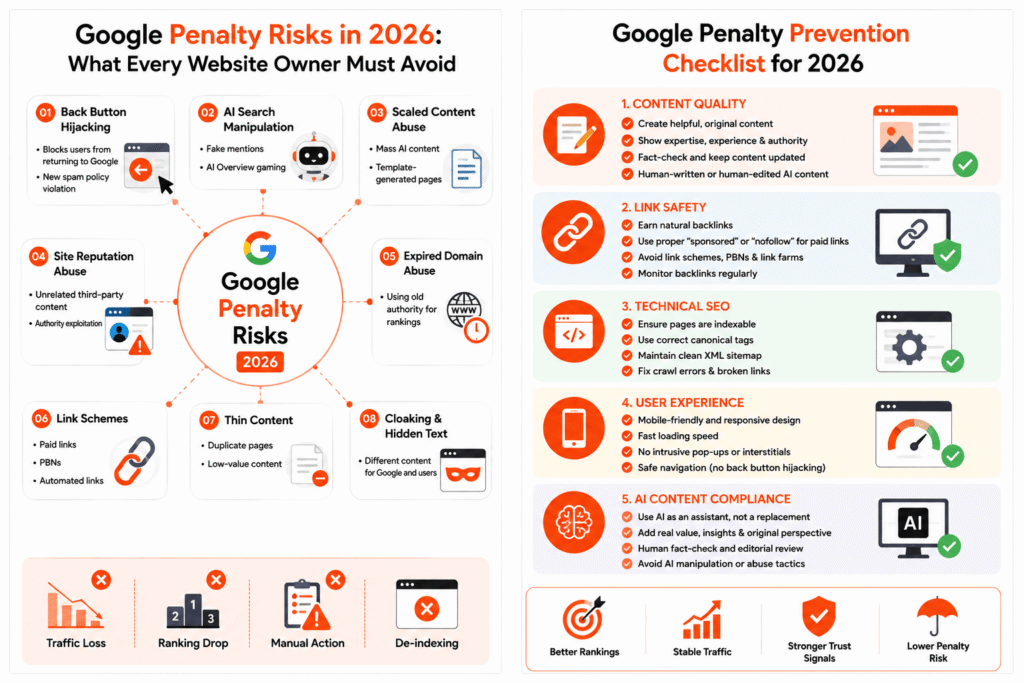
Google’s spam policies define the practices that can result in lower ranking or removal from Search entirely. These policies cover content quality, link manipulation, deceptive practices, structured data abuse, and several categories added or updated in 2026 — back button hijacking and AI search manipulation among them. The spam policies page is the primary reference for any SEO compliance review and is updated by Google as new enforcement areas are introduced.
Key Best Practices
Beyond avoiding violations, Google’s best practices for search performance include:
- Create content that is helpful, accurate, and written for people rather than search engines
- Use words that users naturally search for within content, without forcing exact-match repetition
- Make all important links crawlable using standard HTML anchor tags
- Provide supporting metadata for images, videos, and structured data that reflects visible page content
- Improve how the site appears in search — through structured data, meta titles, and descriptions — using the methods Google recommends, not techniques designed to manipulate appearance
2026 Google Penalty Risks You Should Not Ignore
Google updated and extended its spam policies in 2026. Several of these additions reflect enforcement areas that were not prominent in previous years. Every site owner and SEO practitioner should review these against their current setup.
Back Button Hijacking — New Enforcement in 2026
On April 13, 2026, Google published a blog post on Google Search Central announcing a new spam policy for back button hijacking. The Google Search Central blog post states that interfering with browser back-button behaviour — preventing users from navigating back to the Google Search results page — is now an explicit malicious practices violation under Google’s spam policies.
| 2026 Enforcement: Interfering with the browser back button is now a Google spam policy violation as of 2026. Sites found to use this practice risk manual action or algorithmic demotion. |
Back button hijacking typically appears as JavaScript that intercepts the browser’s history API to prevent the back button from functioning, or that inserts additional history entries so pressing back takes the user to another page on the same site rather than back to Google’s results. It is often introduced unintentionally through ad networks, popups, affiliate tracking scripts, or third-party libraries.
What to check on your site:
- Review any scripts that interact with window.history or window.location
- Test the back button manually on key landing pages — does it return to Google Search results?
- Audit ad network code, popup scripts, and affiliate redirects for history manipulation
- Remove or replace any library or plugin that modifies back-navigation behaviour
Manipulating Generative AI Responses in Google Search
Google’s spam policies now explicitly reference attempts to manipulate its generative AI features, including AI Overviews in Search results. This is a direct response to tactics that emerged when AI-generated summaries began replacing traditional featured snippets for many queries.
Google evaluates what it calls people-first content — information written to genuinely help the reader, backed by real expertise and experience. Content designed to appear in AI summaries through fake mentions, artificial reinforcement loops, or doorway-style pages targeting AI fan-out queries is treated as a manipulation attempt.
- Fake brand mentions in third-party content created only to feed AI training signals
- Pages optimised only to appear in AI summaries, with no genuine user value
- Recommendation poisoning — generating large volumes of positive mentions to influence how AI presents a brand
- Doorway pages structured around anticipated AI fan-out queries without real supporting content
| Tip: The correct approach to AI Overview visibility is content that genuinely answers questions, backed by real experience and structured for clarity. Google’s AI systems favour the same content signals as its traditional ranking systems: depth, trust, relevance, and authority. |
Scaled Content Abuse
Publishing many pages using automation or AI solely to increase the number of pages targeting search queries is a spam policy violation under Google’s scaled content abuse category. The key qualifier is purpose: if the automation produces genuinely useful, original content that would meet Google’s helpful content standards, the method of production is not itself a violation.
The violation is publishing at scale when the content adds no real value — near-identical service pages differing only by city name, product description pages generated from a template with no original information, or AI-generated articles that cover the same topic with minor variations across dozens of URLs.
- Hundreds of city landing pages with the same body text and only the location name changed
- AI-generated product reviews with no real product testing or original assessment
- Template-based FAQ pages that repeat the same answers across multiple domains
- Blog posts published daily on the same narrow topic with no meaningful differentiation
Site Reputation Abuse
Site reputation abuse refers to publishing third-party content that exploits an established site’s authority to rank pages unrelated to the site’s primary purpose. Google introduced this as a formal spam policy violation in 2024 and has continued enforcement through 2026.
The pattern typically appears as: a news site, review site, or authoritative domain publishing coupon sections, payday loan pages, casino affiliate content, or adult content on a subdirectory or subdomain that has no editorial relationship to the main site. The third-party content is placed there specifically to benefit from the domain’s existing authority.
- A technology news site publishing /best-payday-loans/ content managed by an unrelated affiliate
- An educational domain hosting gambling review pages on a subdomain
- A legitimate business site publishing unrelated sponsored content sections with no editorial oversight
Sponsored content and third-party contributions are not prohibited, but they must be relevant to the site’s subject area, properly marked, and subject to editorial standards.
Expired Domain Abuse
Buying an expired domain that previously ranked well and immediately redirecting it to unrelated content, or rebuilding it with low-quality pages designed to exploit its historical authority, is an explicit spam policy violation.
The important distinction: using an expired domain for a genuine new project in the same or a related subject area — with original, people-first content — is acceptable. The violation is the intent to inherit authority rather than to build something genuinely useful.
Common Causes of Google Penalties
Thin, Duplicate, or Low-Value Content
Thin content is any page that does not adequately address the query it appears for. In practice, this includes:
- Service pages that describe an offering in three sentences with no supporting information
- Location pages that repeat the same body text with only the city name changed
- Product descriptions copied verbatim from the manufacturer with no original assessment
- AI-generated articles published without review, fact-checking, or expert input
- Blog posts that summarise what other sites have already written without adding new perspective, data, or experience
Prevention: identify the weakest pages on the site using Google Search Console’s Performance report filtered by landing page. Pages that receive impressions but almost no clicks are candidates for improvement or consolidation. The measure for improvement is whether a real user would find the page genuinely useful after reading it.
Keyword Stuffing and Over-Optimisation
Keyword stuffing is the practice of repeating a target keyword or phrase at an unnatural density in an attempt to manipulate rankings. It can appear in page titles, headings, body paragraphs, image alt text, anchor text, footer blocks, or hidden text.
Over-optimisation is a related issue where every element of a page is forced to include the exact target phrase, resulting in content that reads mechanically rather than naturally. This includes using the same exact-match anchor text on every internal link to a page, repeating a phrase in every paragraph, or filling a sidebar or footer with keyword-rich link blocks.
Prevention: write for readers. If a sentence would sound unnatural spoken aloud, rewrite it. Use synonyms and natural variants where they fit. The keyword should appear where it is relevant, not where it can be inserted.
Link Spam and Paid Link Schemes
Buying or selling links specifically to pass PageRank — the authority signal that feeds rankings — is a direct violation of Google’s spam policies. This includes:
- Paying websites to publish links pointing to a site without marking those links as sponsored or nofollow
- Participating in private blog networks (PBNs) designed to manufacture link authority
- Using automated tools to generate links across directories, forums, or comment sections
- Excessive reciprocal linking arrangements with no editorial basis
- Guest posts on low-quality sites published solely for the link, not for the audience
- Manipulative anchor text strategies that force exact-match keyword phrases into link text at scale
Prevention: build links by creating genuinely useful assets — research, tools, guides, case studies — that other sites link to voluntarily. Where links are paid or sponsored, mark them with rel=”sponsored” or rel=”nofollow” as Google’s guidelines require.
Cloaking, Sneaky Redirects, and Hidden Text
Cloaking means showing different content to Google’s crawler than to human visitors. Sneaky redirects send users who click through from search results to a different page than the one Google indexed. Hidden text uses CSS or other methods to include keyword-rich content that users cannot see but crawlers can.
These practices all share the same intent: to present a misleading picture of page content to Google while delivering a different experience to users. Google’s systems detect these differences and treat them as serious violations.
Prevention: ensure that the content Google crawls is identical to what users see. Audit redirects to confirm they send search users to the expected destination. Remove any blocks of text styled with display:none or positioned off-screen for keyword manipulation purposes.
Hacked Content and User-Generated Spam
A hacked site can have pages injected with links, keyword spam, malware, or redirect scripts without the site owner’s knowledge. Google detects this and may flag the site in Search Console under Security Issues, which can reduce rankings or remove the site from results entirely.
User-generated content — comments, forum posts, profile pages, and review submissions — can be exploited by spammers who post links and keyword-stuffed content to gain link authority from the host domain.
Prevention: keep the CMS, plugins, and themes updated. Run regular security scans. Use CAPTCHA or moderation on comment and submission forms. Review the Security Issues report in Google Search Console monthly. Restrict file upload permissions to authenticated users only.
Abusive Structured Data
Structured data schema tells Google what type of content a page contains — product information, review ratings, FAQ answers, event details, and similar. When structured data does not match what is actually visible on the page, it is treated as a manipulation attempt.
Examples of schema abuse:
- Adding 5-star AggregateRating markup to pages with no real reviews from real users
- Adding FAQPage schema to content that is not actually written in a question-and-answer format
- Using Product schema with incorrect or invented pricing on affiliate pages
- Marking content as authored by a named expert when no such expert reviewed it
Prevention: add structured data only for content types that are genuinely present and visible on the page. Test all schema using Google’s Rich Results Test before publishing. Remove schema that was added optimistically but does not reflect visible content.
Doorway Pages and Location Page Abuse
Doorway pages are sets of near-identical pages created to rank for many keyword or location variations, where each individual page provides little unique value. A business creating 200 city pages — each with the same service description, different city name, and no other local content — is building a doorway page set.
These pages create a poor user experience because the content is not genuinely tailored to the location. They also create index bloat — large numbers of thin pages that dilute the crawl budget and quality signals of the site.
Prevention: each location or service page should contain genuinely unique content: real testimonials from local clients, local case studies or results, service area-specific information, local contact details, and answers to questions that vary by location. If creating a unique, useful page for a given location is not possible, do not create it.
Aggressive Ads, Popups, and Deceptive UX
Pages with intrusive interstitials, misleading buttons, deceptive navigation, or aggressive ad placements that cover main content create poor user experiences. Google’s Page Experience signals measure some of these conditions directly through layout shift and interactivity metrics.
Misleading UX patterns — fake close buttons on ads, download buttons that trigger unintended actions, or navigation that looks like content — can qualify as deceptive practices under Google’s spam policies.
The 2026 addition of back button hijacking to the malicious practices list extends this category explicitly to navigation manipulation. Any script, popup, or redirect that prevents users from returning to Google Search results is now in the same risk category as cloaking and hidden text.
How to Avoid Google Penalties: Practical Prevention Checklist
The following checklists are designed for regular review — ideally monthly for active sites, and before and after any significant site change.
Content Quality Checklist
- Does each page solve a specific, real user problem clearly and completely?
- Does it add original value — data, examples, first-hand experience, expert input — beyond what competitor pages already cover?
- Is there visible proof of experience or expertise? This includes real photos, case studies, client results, or named authorship where relevant.
- Is the page written for readers first, with keywords appearing naturally rather than forced?
- Have weak pages — those with traffic but no conversions, or impressions with near-zero clicks — been reviewed for improvement or consolidation?
- Has AI-assisted content received human review, fact-checking, and editorial refinement before publication?
Link Safety Checklist
- No links have been purchased for ranking value from any source
- Paid or sponsored links carry rel=”sponsored” or rel=”nofollow” attributes
- No PBN (private blog network) links are in the active backlink profile
- No automated link-building tools have been used
- The backlink profile has been reviewed in the past 30 days for unusual spikes or suspicious anchor text patterns
- Disavow file entries are current and limited to links with clear evidence of spam or harm — the disavow tool is not used speculatively
Technical SEO Checklist
- All key pages are confirmed as indexable — no accidental robots.txt blocks or noindex tags
- Canonical tags point to the correct preferred URL on all duplicate or near-duplicate pages
- The sitemap is clean, current, and submitted to Search Console
- Soft 404s — pages that return 200 status but display no content — have been identified and resolved
- Redirect chains longer than one hop have been reduced to direct redirects
- JavaScript-rendered content on important pages has been tested in Google’s URL Inspection tool
- Internal links to key pages are functioning and use descriptive anchor text
User Experience and Trust Checklist
- No scripts, plugins, or ad networks on the site manipulate the browser back button
- Popups and interstitials on mobile do not cover the main content before the user interacts with the page
- No deceptive buttons, fake close controls, or misleading download prompts are present
- Contact, privacy policy, and terms of service pages are accessible from every page
- Author credentials or business information are visible on content pages where expertise or trust is relevant to the reader’s decision
AI Content Checklist for 2026
- AI tools are used to assist writing — researching, drafting, suggesting structure — not to produce finished content without review
- Every AI-assisted page has received human editing, fact-checking, and quality review before publication
- No bulk publishing of AI-generated pages targeting slight variations of the same query
- No tactics designed to manipulate AI Overview responses or artificial citation signals
- Editorial standards applied to AI-assisted content are the same as those applied to manually written content
How to Monitor Your Website Before a Penalty Happens
Monitoring does not prevent all issues, but it significantly reduces the time between an issue appearing and the site owner knowing about it. Early detection means faster resolution and less traffic loss.
Google Search Console: What to Check and How Often
Google Search Console is the primary monitoring tool for search visibility. The following reports should be reviewed on a set schedule:
- Manual Actions report (monthly): go to Security & Manual Actions > Manual Actions. Any entry here requires immediate attention. A clean report is the expected baseline.
- Security Issues report (monthly): go to Security & Manual Actions > Security Issues. Hacked pages, malware, and deceptive content findings appear here.
- Coverage / Indexing report (monthly): review for any increase in excluded or error pages. A sudden spike in Not indexed pages may indicate a crawl or noindex issue.
- Performance report (weekly): track clicks and impressions over time. Set a comparison period of the same dates last year to separate seasonal changes from ranking changes. Look for drops on specific pages or query clusters.
- Links report (monthly): review the top linking domains for new entries that look unnatural or from irrelevant low-quality sites.
Analytics: What Patterns Indicate Risk
Google Analytics provides the user-side view that Search Console does not. Compare organic traffic month-on-month and year-on-year for the same period. Specific patterns worth investigating:
- A sudden drop in organic sessions from a single entry date — coinciding with a known algorithm update or a site change
- A drop in organic sessions from specific countries or device types while overall traffic holds — may indicate a technical rendering issue
- A sharp increase in bounce rate on landing pages that previously performed well — may indicate content quality, page speed, or UX deterioration
- Zero organic sessions on pages that should be receiving traffic — may indicate a noindex tag or crawl block introduced by a site update
Monthly SEO Health Audit
A crawl-based audit catches issues that neither Search Console nor Analytics surfaces directly. Using Screaming Frog, Sitebulb, or a similar crawler, run a full site crawl monthly and check:
- 404 errors on pages that were previously live — check whether they have received backlinks that are now wasted
- 3XX redirect chains — any chain longer than one hop should be reduced to a direct redirect
- Canonical tag accuracy — verify that canonical tags point to the intended URL, not to a different page due to a template error
- Duplicate title tags and meta descriptions — indicate pages with overlapping intent that may benefit from consolidation
- Thin pages — identify pages under 300 words with no significant engagement
- Orphan pages — pages with no internal links pointing to them, meaning Google is unlikely to discover or value them
For websites that have not had a formal technical review recently, a structured SEO audit identifies the backlog of technical and content issues that monthly monitoring alone may miss.
What to Do If You Already Have a Manual Action
A manual action is a formal notification from a Google reviewer. It does not require guesswork about the cause — Google identifies the category of violation in the notification. The process for resolving it is structured.
Step 1: Confirm the Issue in Search Console
Go to Google Search Console > Security & Manual Actions > Manual Actions. Check whether the action is site-wide (affecting the entire domain) or partial (affecting specific URLs or sections). If Google provides sample URLs, review each one to understand the exact nature of the violation.
The manual action message describes the policy category. Common categories include: unnatural links to your site, unnatural links from your site, thin content with little or no added value, pure spam, cloaking and sneaky redirects, and user-generated spam.
Step 2: Fix the Issue Completely
Fixing a sample of affected pages is not sufficient. Google expects the underlying issue to be fully resolved across the entire site.
- For link-related manual actions: contact the linking domains and request removal. Document every outreach attempt. Where removal is not possible, prepare a disavow file containing the remaining problematic domains.
- For content quality actions: improve, consolidate, or remove every page that matches the violation pattern — not just the sample URLs Google identified.
- For hacked content: remove all injected content, close the vulnerability, update all software, and change all admin credentials.
- For structured data violations: remove or correct schema that does not match visible page content across the entire site.
| Important: Do not submit a reconsideration request until all affected pages are fixed and Google can access the corrected versions. Submitting early with unresolved issues reduces the likelihood of a positive outcome and delays the review process. |
Step 3: Document the Cleanup
Maintain a spreadsheet that records every affected URL, the specific issue identified, the action taken, the completion date, and evidence of the fix. For link issues, include records of outreach emails sent and responses received.
Google does not require documentation in a specific format, but a clear record demonstrates that the cleanup was thorough and systematic. This also helps if the reconsideration request is rejected and additional work is needed.
Step 4: Submit a Reconsideration Request
In Search Console, go to the Manual Actions report and click the Request Review button. The request should include:
- A clear description of what the specific violation was
- A detailed account of the steps taken to fix it — which pages were changed, which links were removed, which disavow entries were added
- An explanation of what changes have been made to prevent the same issue recurring
The review process typically takes several weeks. Google does not confirm receipt with a timeline estimate. Check the Manual Actions report periodically for a status update.
Step 5: Do Not Resubmit Before Google Responds
Submitting multiple reconsideration requests before Google reviews the first one does not speed up the process and may be treated as incomplete cleanup. Wait for Google’s assessment.
If the request is rejected, Google will provide a reason. Review the feedback, address any remaining issues, and document the additional fixes before submitting again.
What to Do If Rankings Drop but There Is No Manual Action
A significant traffic drop without a manual action notification is more common than an actual manual action and requires a different diagnostic process.
Diagnose Before Assuming a Penalty
Run through this checklist before beginning any site changes:
- Check the Google Update timeline — searchengineland.com and Google Search Central blog track confirmed update dates. Cross-reference with your traffic drop date.
- Check Search Console Coverage for new indexing errors introduced around the drop date
- Check whether robots.txt, noindex tags, or canonical tags changed on key pages
- Check whether a technical deployment happened around the same time
- Review whether seasonal traffic patterns explain the change — compare to the same period in the previous year
- Review whether competitor pages on the same queries significantly improved
Review Content Quality Site-Wide
If an algorithm update coincides with the traffic drop, the standard response is a content quality review. Core updates typically reward or demote content based on E-E-A-T signals — experience, expertise, authoritativeness, and trustworthiness.
For each page with significant traffic loss, assess:
- Does the page answer the query it ranks for more thoroughly than the pages that displaced it?
- Is there first-hand experience or expertise demonstrated — real examples, original data, named authorship?
- Does the page have visible trust signals — accurate business information, clear authorship, up-to-date content?
- Is the content aligned with what users searching that query actually need, or has it drifted toward what was easy to produce?
Review Technical and Link Signals
If content quality is not the clear cause, a technical or link-related change may have reduced authority or indexability:
- Check whether internal links to affected pages were reduced by a template or navigation change
- Check whether a new canonical tag variation is sending authority to the wrong URL
- Check whether the backlink profile shows a sudden drop in quality links — existing links removed from other sites
- Check whether duplicate page versions were introduced, splitting authority
Google Penalty Prevention by Website Type
The specific risks vary by the type of site. The following guidance targets the most common penalty patterns for each category.
Local Business Websites
The most common local SEO penalty risk is a set of near-identical location pages created to capture every service area without genuine local content. Each page should contain:
- A unique local service description specific to that city or area — not a template with the city name substituted
- Real photos of local projects, the team, or the business premises
- Testimonials from clients in that location, with enough detail to be credible
- Service area-specific information such as local building codes, common local issues, or area-specific service details
- Local contact information and a map or service boundary description
Ecommerce Websites
Ecommerce sites face several common risk areas: copied manufacturer product descriptions, index bloat from filter-generated URL variations, fake or imported reviews, thin category pages, and misleading product schema.
- Write original product descriptions that go beyond manufacturer copy — describe fit, use case, comparison to alternatives, or buyer experience
- Use canonical tags or noindex on filter-generated URLs to prevent index bloat
- Only use AggregateRating schema when the ratings data comes from genuine verified purchases
- Add content to category pages — buying guides, comparison information, or editorial context — that gives Google something to evaluate beyond the product grid
Affiliate Websites
Affiliate sites are under sustained scrutiny from Google’s helpful content and product reviews systems. Sites that publish review pages without real testing, or that copy product specifications from manufacturer pages, consistently see demotion in product review update cycles.
- Every review should document what was actually tested, by whom, and how
- Include original photos, test results, or comparisons not available on the product page
- Disclose affiliate relationships clearly on every page where they appear
- Avoid publishing reviews for products you have never evaluated — provide genuine recommendations based on real experience
News and Publishing Websites
Site reputation abuse is the primary risk for established news and publishing domains. Third-party content sections — coupon sites, sponsored finance content, gambling reviews — hosted on authority domains to benefit from inherited ranking signals are an explicit enforcement target.
Any third-party content published under an established domain should be editorially reviewed, relevant to the site’s subject area, and properly disclosed. Sponsored content or native advertising sections must be clearly marked as such and should not host content from industries unrelated to the publication’s editorial focus.
AI-Content Websites
Sites built on scaled AI content output face the highest risk from Google’s scaled content abuse and helpful content systems. Volume without quality is the pattern Google’s systems target.
- Set and enforce a minimum quality standard for every published page — word count, expert review requirement, original element requirement
- Audit the existing content catalogue for pages that add no genuine value and either improve or remove them
- Establish a clear editorial workflow where AI drafts are reviewed, fact-checked, and improved before publication
- Avoid publishing multiple pages targeting slight variations of the same query across the same or related domains
Final Prevention Framework: Build for Users, Audit for Google Compliance
Google penalty prevention is not a single setting or a one-time fix. It is an ongoing operational standard that applies to every content decision, every link acquired, every technical change, and every new feature added to a site.
The practical framework is:
- Publish content that solves real problems for real readers, with visible experience or expertise behind it
- Build links through genuine value creation — not through purchase, manipulation, or network schemes
- Maintain a clean technical foundation — correct indexability, accurate canonical tags, no redirect errors, no crawl blocks on live pages
- Review the site regularly through Google Search Console and an independent crawl tool
- Treat every 2026-specific risk — back button hijacking, AI manipulation attempts, scaled content, site reputation abuse — as a compliance requirement rather than an optional consideration
- When an issue is found, resolve it fully and document the resolution before reporting to Google
For businesses that want a structured review of their current compliance position, Thanksweb offers an SEO audit and technical review that covers Google Search Console status, content quality, link profile health, and technical SEO compliance. See the SEO packages page for details on what is included at each level.
FAQs About Google Penalties
A Google penalty is a reduction or removal of a website’s search visibility caused by a violation of Google’s spam policies. It can be a manual action — applied by a Google reviewer and visible in Search Console — or an automated demotion from a spam, helpful content, or core update. The two types have different causes and require different responses.
Check Google Search Console under Security & Manual Actions > Manual Actions. A manual action will be listed there with the affected URLs and policy category. If no manual action appears, but traffic has dropped, the site may have been affected by an algorithmic update — check the Performance report for the drop date and compare it to known Google update releases.
A manual action is a formal notification issued after a Google reviewer determines the site violated a spam policy. It appears in Search Console and has a reconsideration request process. An algorithm update is an automated change to how Google evaluates all sites — it does not produce a notification and typically requires improving content quality, link health, or technical signals to recover from.
AI-generated content does not automatically cause a penalty. Content quality is the standard, not the production method. Content published at scale using AI, without human review or original value, can violate Google’s scaled content abuse policy. Individual pages that use AI assistance but are reviewed, fact-checked, and written to genuinely help readers meet Google’s standards.
A manipulative link profile — links that were purchased, generated through PBNs, or built through automated tools — can result in a manual action for unnatural links. Google’s SpamBrain system also detects and discounts low-quality links algorithmically. Natural links from genuine editorial sources do not create penalty risk.
Yes. Keyword stuffing — repeating a target phrase at an unnatural density in titles, headings, body content, alt text, or footer blocks — is still an active violation under Google’s spam policies. It produces content that reads poorly and signals manipulation rather than expertise. Using keywords naturally and varying phrasing is the correct approach.
Site reputation abuse is the practice of publishing third-party content on an established domain specifically to benefit from that domain’s ranking authority, when the content is unrelated to the site’s primary purpose. Examples include coupon sections, payday loan pages, or gambling content hosted on news or educational domains. Google treats this as a spam policy violation and can demote the host site.
Scaled content abuse is publishing many low-quality pages — often generated using automation or AI — where the primary purpose is ranking manipulation rather than helping users. Near-identical location pages, template-generated product reviews, and bulk AI articles published without review are the most common examples. The size of the output and the lack of genuine value are both factors in how Google assesses the violation.
Back button hijacking is a practice where scripts modify browser navigation history to prevent users from returning to Google Search results when they press the back button. Google published a formal spam policy for back button hijacking on April 13, 2026, making this an explicit malicious practices violation. Sites found to use this practice risk manual action. The behaviour is often introduced unintentionally through ad networks, popup scripts, or affiliate tracking libraries.
The Manual Actions and Security Issues reports should be checked at minimum monthly. The Performance report benefits from weekly review during active campaigns or after site changes. The Coverage and Links reports are useful on a monthly audit cycle. Setting up email alerts in Search Console for manual actions and security issues provides immediate notification without manual checks.
Manual action recovery depends on how quickly the underlying issue is fixed and how long Google’s review takes — typically several weeks to a few months after a successful reconsideration request. Algorithmic recovery, which requires improving content or technical quality rather than a formal review, can take one or more core update cycles — often three to six months — before significant traffic improvement is visible.

Gaurav Tank is the CEO & Founder of Thanksweb Marketing Pvt. Ltd. With expertise in SEO, digital marketing, lead generation, and business growth, he shares practical insights on online marketing and entrepreneurship.