
AI search has quietly rewritten the visibility rulebook. The question for brands in 2026 isn’t just “How do I rank on Google?” — it’s “How do I get mentioned inside the answer itself?” Over the last 18 months, we’ve audited dozens of client sites for AI Overview and ChatGPT visibility, and the playbook that actually works is very different from classic SEO. Here’s what the latest 2026 data shows, and what we now recommend to every brand that wants to be cited — not just ranked.
Why AI Citations Are Now a Search Channel of Their Own
AI-generated answers no longer sit on the side of the search results page. They sit on top of it. BrightEdge reported in February 2026 that AI Overviews were appearing on nearly half of tracked queries — meaning a large share of users now read an AI-written answer before they ever click a blue link. If your brand is not inside that answer, you’re effectively invisible for that query, even when you rank.
That single shift is why we now treat AI citation visibility as its own search channel at Thanksweb, with its own measurement, its own optimisation cycle, and its own reporting layer separate from traditional rankings.
The Myth: “If I Rank #1, I’ll Get Cited”
The biggest mistake we still see in 2026 is the assumption that strong organic rankings automatically translate into AI citations. The data does not support that. In March 2026, Ahrefs analysed 863,000 SERPs and roughly 4 million AI Overview URLs and found that only 37.9% of AI Overview citations came from pages that also ranked in the top 10 for the same query. The remaining 62.1% came from pages ranking 11–100, or from pages not ranking in the top 100 at all.
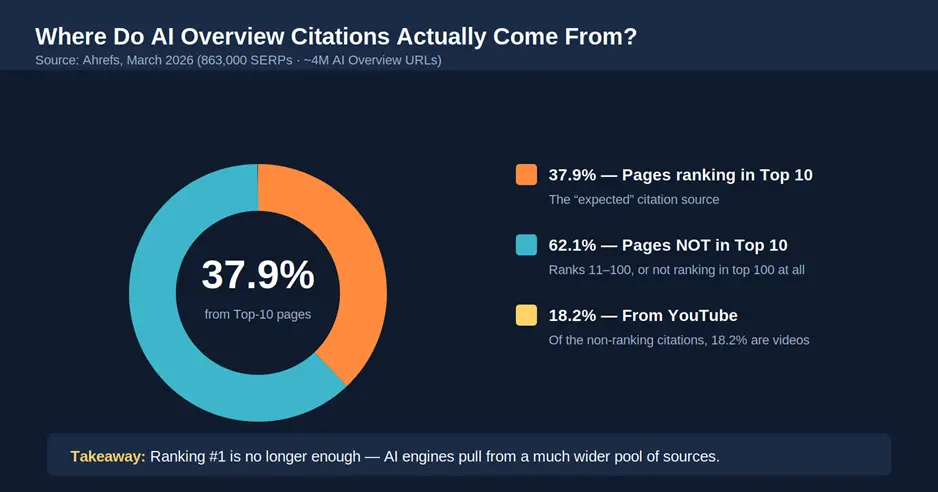
The same study found that 18.2% of non-ranking AI Overview citations came from YouTube. That’s a real signal. AI engines are pulling from videos, transcripts, forums, and explainers — not just from your money pages. So a brand’s AI citation strategy has to reach beyond the website itself.
The Four Things AI Engines Actually Look For
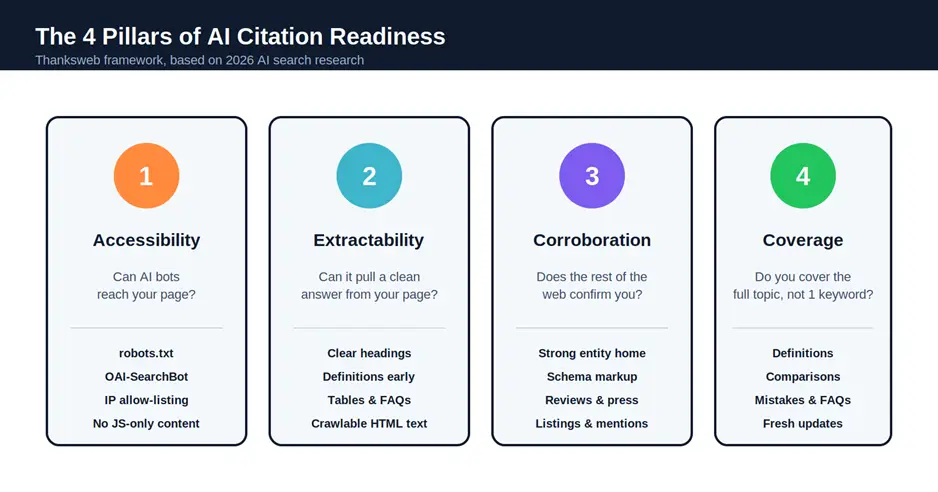
Across the 2026 evidence — Ahrefs, BrightEdge, OpenAI’s publisher guidance, Microsoft’s new Bing reporting, and Search Engine Land’s entity-home work — four factors keep showing up in pages that get cited consistently. We use these as our internal audit framework when reviewing client sites.
1. Accessibility — Are AI Bots Even Allowed In?
This sounds basic, but on real audits we still find sites that quietly block AI search crawlers in robots.txt or behind aggressive bot protection. OpenAI’s publisher guidance is explicit: if you want to appear in ChatGPT’s search results, you should allow OAI-SearchBot in robots.txt and accept requests from OpenAI’s published IP ranges. If you don’t, you’re simply not in the eligible pool. OpenAI also confirms that publishers can track ChatGPT referral traffic using the URL parameter utm_source=chatgpt.com, which makes attribution far more measurable than people assume.
What we do for clients: a quick crawler-access audit covering Googlebot, Bingbot, OAI-SearchBot, ChatGPT-User, PerplexityBot, and Google-Extended. If any of those are blocked and the brand actually wants AI visibility, we open them up before anything else. Our technical SEO process now includes this as a default check.
2. Extractability — Can the AI Pull a Clean Answer Out of Your Page?
AI engines reward pages they can confidently lift a sentence or paragraph from and use as grounded evidence. Microsoft made this expectation more visible in February 2026 when it launched AI Performance in Bing Webmaster Tools — a new report showing total citations, cited pages, grounding queries, and visibility trends. Microsoft’s own guidance says publishers can use it to improve pages that are indexed but cited less often, by improving clarity, structure, or completeness. That’s an unusually direct hint at what AI engines actually favour.
Pages that get cited tend to share the same DNA. They answer the question early, before scrolling. They use descriptive headings instead of clever ones. They break complex topics into clean sections, with a definition, a comparison, a short summary, a table where useful, and a small FAQ. The most important sentences live in crawlable HTML text, not inside an image or a PDF or behind a tab that needs JavaScript to open. A useful test: copy the first 120 words of your page. If they don’t answer the page’s headline question, an AI model won’t use it as a citation either.
3. Corroboration — Do You Look Like a Real Entity?
In 2026, AI citation visibility is not just about what your page says. It’s about what the rest of the web confirms about you. Search Engine Land’s March 2026 work on the “entity home” concept argues that every brand needs a central page — usually the About page — that clearly explains who the brand is, what it does, what it’s known for, and how it should be interpreted by both users and machines. That entity home is then supported by pillar content on your site and by third-party signals across the web (reviews, listings, press, expert mentions, case studies).
Schema fits in here, but not as a magic switch. Search Engine Land’s March 2026 schema analysis is direct about it: schema markup does not guarantee AI citations. What it does is make your entities, relationships, and page purpose easier for machines to parse. Treat schema as a clarity tool, not a ranking trick. Our SEO services include Organization, Product, FAQ, and Article schema by default for this reason.
4. Coverage Depth and Freshness
One reason a top ranking alone isn’t enough is that AI systems often break a single prompt into several sub-questions before generating an answer. A thin page targeting only the head term doesn’t survive that decomposition. Brands that get cited consistently tend to cover the whole topic environment — definitions, alternatives, comparisons, pricing, common mistakes, examples, pros and cons, and follow-up questions. The Ahrefs 2026 overlap data backs this up: AI Overviews are not drawing only from the obvious top-ranking pages, which means deeper topic coverage gives the model more places to retrieve a useful passage.
Freshness matters more than people think. Microsoft’s AI Performance guidance specifically points publishers toward reviewing cited pages and improving the indexed-but-under-cited ones. That tells you the citation slot is dynamic — pages that go stale lose visibility even if they remain indexed. Refreshing content in 2026 isn’t only about defending rankings. It’s about staying citation-worthy.
Different AI Engines Cite Differently — Don’t Run One Playbook
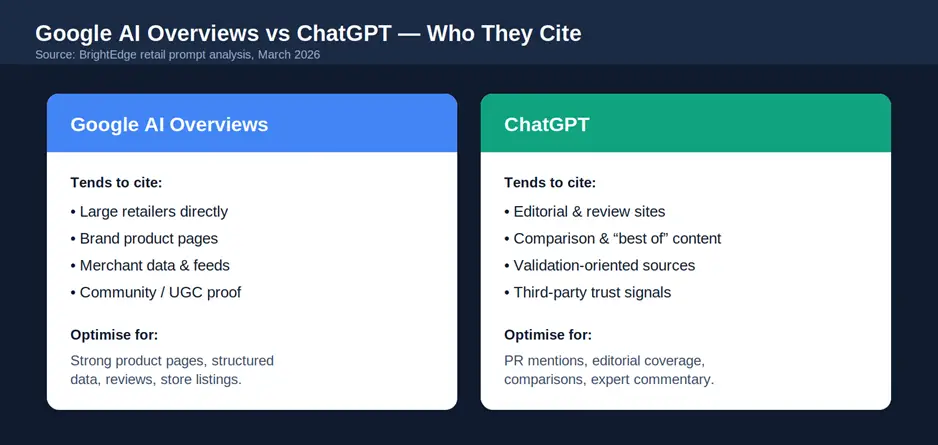
One of the most useful 2026 findings, and one we now build into client strategies, is that AI platforms are not interchangeable. BrightEdge’s March 2026 research on retail prompts found that Google AI Overviews tended to cite large retailers directly far more often, while ChatGPT leaned more heavily on editorial and validation-oriented sources. In practice, that means the same brand may need two slightly different content investments depending on which surface it’s chasing.
For ecommerce brands the picture is even more concrete. OpenAI’s March 2026 product discovery update confirmed that merchants can share product feeds so their catalogs are better represented inside ChatGPT shopping experiences. In other words, AI visibility for product-related answers now depends on structured, machine-readable product information in addition to on-page content. If you run an online store, your product feed is now part of your AI citation strategy. If you’re not sure whether yours is set up cleanly, this is the kind of thing our ecommerce SEO services audit on a regular basis.
How This Connects to Google’s E-E-A-T Guidance
None of this is in conflict with Google’s long-standing direction. In its February 2023 guidance on AI-generated content — still the canonical reference Google points creators to — Search said the focus is on the quality of the content, not how it was produced, and that creators should aim for original, helpful, people-first content that demonstrates Experience, Expertise, Authoritativeness, and Trustworthiness (E-E-A-T). Google’s Creating Helpful, Reliable, People-First Content page is even clearer that of the four E-E-A-T qualities, trust is the most important, and that creators should be able to answer Who created it, How it was created, and Why.
What changed in 2026 isn’t the quality bar — it’s how that quality gets retrieved. AI engines are essentially machine readers applying the same principles: a clearly authored page, with a real entity behind it, that answers a real question, supported by external corroboration. E-E-A-T was always about being a trustworthy source. AI search just made “trustworthy enough to be quoted” an explicit, measurable outcome.
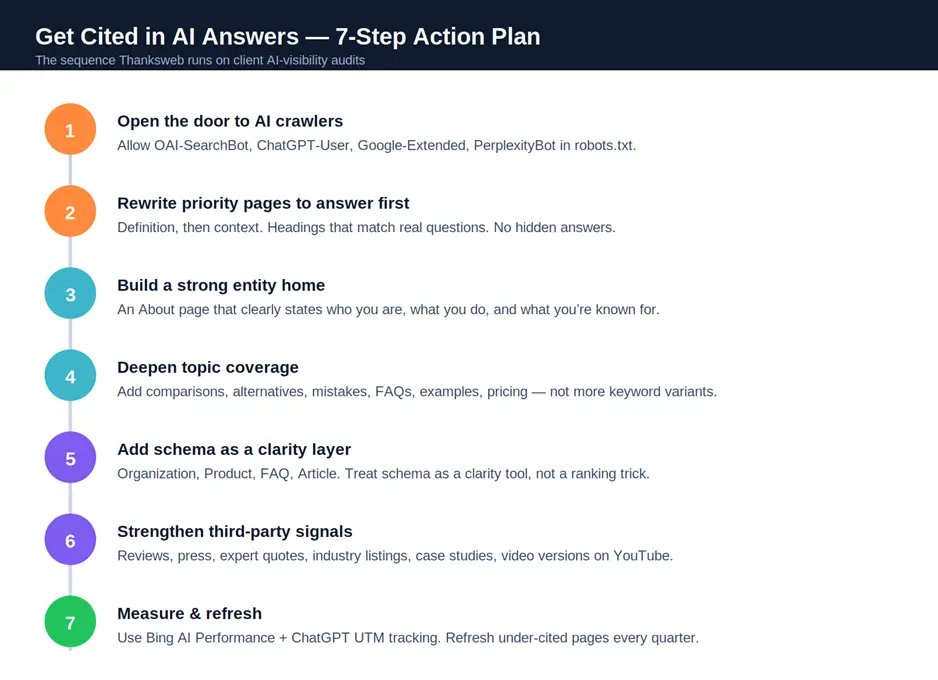
The 7-Step Action Plan We Use With Clients
If your brand wants to be cited in AI answers, this is the order we actually run things in. It’s not glamorous, but it’s the sequence that consistently moves the needle.
Yes, You Can Finally Measure AI Visibility
The encouraging news in 2026 is that AI citation visibility has stopped being a black box. Bing’s new AI Performance report inside Webmaster Tools (launched February 2026) gives site owners direct data on citations, cited pages, grounding queries, and visibility trends. OpenAI provides referral tracking for ChatGPT traffic via the utm_source=chatgpt.com parameter, which flows straight into GA4 as a normal source/medium. Between those two, you can build a basic AI visibility dashboard for almost any client without any third-party tooling.
That measurability matters. Once you can see which pages are getting cited, which are indexed but ignored, and which ChatGPT prompts are sending you traffic, AI search becomes a normal optimisation loop instead of a guessing game. That’s the workflow our SEO team now runs on every client engagement.
FAQs: Getting Cited in AI Answers
No. Ahrefs’ March 2026 study of 863,000 SERPs found that only 37.9% of AI Overview citations came from top-10 ranking pages for the same query. The rest came from pages ranking 11–100 or from pages not ranking in the top 100 at all.
No. Per Search Engine Land’s 2026 reporting, schema helps AI systems understand entities and relationships more clearly, but it does not guarantee citations on its own. Treat it as a clarity tool, not a ranking trick.
OpenAI confirms that publishers can track ChatGPT referral traffic because URLs include the parameter utm_source=chatgpt.com, which is visible in GA4 and most analytics tools as a normal source.
Yes. Bing launched AI Performance in Webmaster Tools in February 2026, giving site owners direct reporting on citations, cited pages, and grounding queries. Combined with ChatGPT referral tracking, AI search can now be measured and improved like any other channel.
Content that is crawlable by AI bots, clearly structured with descriptive headings, complete on its topic, current, and supported by trustworthy entity and third-party signals. In short: content that already looks like a clean source of truth.
The Bigger Shift
Traditional SEO was about ranking pages. AI search is about being a source that answer engines can retrieve, parse, verify, and quote. That’s a different game, and it rewards a different kind of content — clearer, more complete, more verifiable, and more honestly tied to a real entity. It happens to be exactly the kind of content Google’s E-E-A-T guidance has been pointing at for years.
If you want help auditing your site for AI citation readiness — robots access, entity home, schema, content depth, and measurement setup — our team does this work every day. You can talk to the Thanksweb SEO team here.

Kishan Jadav is the Project Manager of Thanksweb Marketing Pvt. Ltd. With expertise in Technical SEO, Local SEO, web development, and digital strategy, he helps businesses boost online visibility, organic traffic, and leads through data-driven marketing.