




Search engine optimisation is the backbone of online store success. But a lot of e-commerce businesses make simple mistakes that kill the rankings. The errors stop Google from understanding your store stop, and that means minimal visitors or fewer sales. In this guide, you can learn everything about the most common e-commerce SEO mistakes.
Why Avoiding Seo Mistakes is So Important?
Your online store could have great products. But no one will find them without good SEO. SEO mistakes can drop your rankings and reduce organic traffic while also lowering sales or conversions.
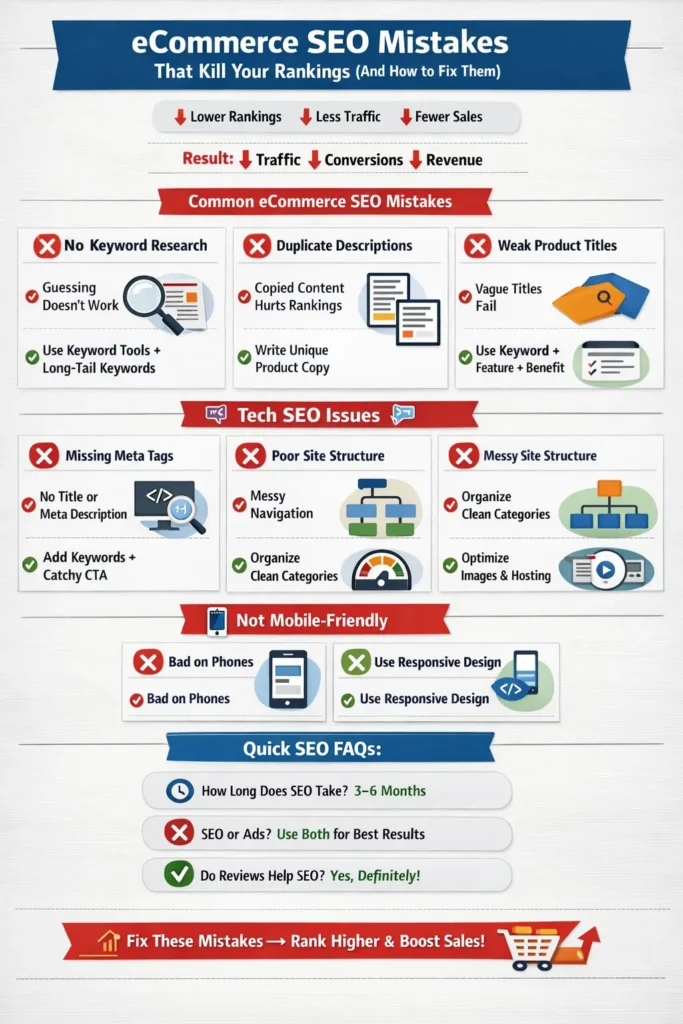
No Keyword Research
You might think that you know what customers search, but assumptions do not work in seo. Keyword research tells you what people are searching for, which words bring buyers. You must use tools like Google Keyword Planner and find long tail keywords that bring buyers.
Duplicate Product Descriptions Explain
It is one of the biggest Ecommerce SEO killers. You might copy descriptions from brands or suppliers, but Google hates duplicate content. It also ranks them lower. For example, if all shoes have the same description from the brand, Google sees duplicate content, and that kills rankings. So you can write unique descriptions for each product and include the benefits and features which is for and why it special.
Weak Product Titles
Your product title must be clear and keyword-rich. A lot of owners today use vague titles. Good titles make it easy for both Google and buyers. So you must always use a formula primary keyword feature and benefit.
Missing Meta Titles and Descriptions
Titles and descriptions actually are what show up in Google. Missing them is a huge problem. These help users decide to click your store. You must always include the main keyword and an attractive phrase.
Poor Site Structure
A messy website makes it challenging for Google to crawl your page. A good site structure helps search engines understand all the pages, and users find the products fast.
Slow Website Speed
Slow loading time kills rankings and conversions. Online shoppers don’t wait. If your website is taking more than three seconds to load bounce rate increases, and Google ranks you lower. You can compress images and use fast hosting, and also enable catching. You can check speed with Google Page Speed Insights and other tools.
Not mobile-friendly
Today, a lot of shoppers browse on phones. If your store is not optimised, you lose traffic. Google also prioritises mobile versions. Make sure that the buttons are really easy to click and the text is readable.
Not using Schema Markup
Schema markup helps Google show rich snippets. Rich snippets can include price reviews or availability. This improves the click-through rate. This makes your listing stand out on Google, and also ask your developer to implement product schema. It’s a standard practice for eCommerce SEO pros like Thanksweb.
SEO is not only one big task, but it’s also many small steps done right. Avoid all these mistakes, and your topic will grow. Your online store can rank higher and attract buyers, and make more sales.
FAQ’s About eCommerce SEO Mistakes
1. What common SEO mistakes make ecommerce sites fail to rank?
Ecommerce sites often fail because they ignore fundamentals of SEO. Common errors include poor keyword research, duplicate content, slow site speeds, weak on-page optimization, and technical crawl issues. These prevent search engines from properly indexing and valuing pages, cutting off organic traffic and rankings.
2. Why does duplicate content hurt ecommerce SEO rankings?
Duplicate content confuses search engines about which page should rank. When multiple product or category pages use the same description (like manufacturer text), Google may not show any of them prominently — splitting ranking value and lowering visibility.
3. How important is keyword research for ecommerce SEO?
Keyword research is critical. Targeting broad, highly competitive terms without understanding user intent usually yields traffic with low conversion. Focusing on long-tail, buyer-intent keywords helps your pages rank for queries where customers are ready to purchase.
4. Does site speed affect ecommerce search rankings?
Yes — site speed and Core Web Vitals influence both user experience and rankings. Slow pages increase bounce rates and signal poor UX to search engines, which can lower ranking positions. Fast loading sites rank and convert better.
5. Can poor mobile optimization kill ecommerce SEO rankings?
Absolutely. Google uses mobile-first indexing, meaning the mobile version determines rankings. Sites that are not responsive or mobile-fast will see falling organic positions and higher bounce rates.
6. What on-page SEO mistakes harm ecommerce rankings most?
Common on-page failures include missing/duplicate title tags, poor meta descriptions, unclear headers, and unoptimized URLs. These elements tell search engines what your page is about — missing or weak signals make ranking harder.
7. How does weak internal linking affect ecommerce SEO?
Weak internal linking breaks site architecture. Strong internal links help Google discover key pages, pass ranking authority, and connect related content — boosting indexing and relevance. Without it, even good pages can remain buried.
8. Why is technical SEO critical for ecommerce rankings?
Technical SEO ensures crawlability, indexability, and site health. Issues like broken links, missing sitemaps, improper canonical tags, and URL problems reduce how well search engines can understand and rank your site.
9. Do missing user reviews impact ecommerce SEO?
Yes — reviews create fresh, unique content and improve trust signals. Search engines see user-generated content as valuable, and review snippets (with schema) can also improve search appearance and click-through rates.
10. How long does it take to see SEO results for ecommerce?
SEO is a long-term strategy. Typically, foundational fixes (speed, structure, pages) take 0–3 months to reflect, early ranking traction appears around 3–6 months, and strong compounding results usually emerge after 6–12+ months. Short timelines often lead to misunderstanding and early abandonment
You can read more about eCommerce SEO: